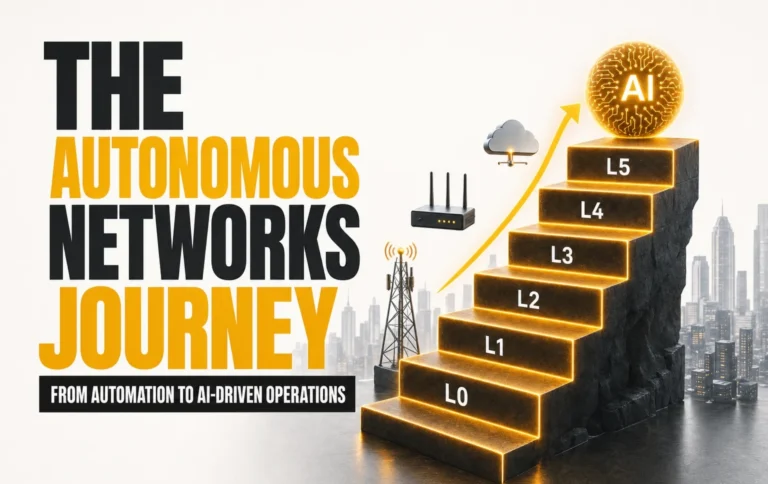
The strategy is no longer the hard part. Almost every operator has already declared a direction toward autonomous, AI-driven, intent-based operations, and the industry has agreed on a common vocabulary through the TM Forum Autonomous Networks framework and its six-level scale (TM Forum IG1252). The gap that actually separates the leaders from the stalled programs is not vision and not model choice. It is the ability to industrialize: to build a small set of operational foundations once and reuse them across every process, in every domain, at production scale and under control.
This article is deliberately not another maturity-level explainer. A companion piece covered the levels, the certified cases and the business value — the roughly US$794 million of annual capex, opex and revenue upside that STL Partners models for an average operator moving up the autonomy curve (STL Partners). What follows is the engineering-grade build guide: the concrete foundations you assemble, how each one is reused by every operational process, the closed-loop engine that runs behind all of them, the pipeline and guardrails that let AI act on a live network without breaking it, and then a process-by-process and domain-by-domain walkthrough of what “automated” actually means for each one.
The thesis: autonomous operations are not built by stacking automations. They are built by turning inventories, alarms, KPIs, configuration and topology into reusable, governed assets — a shared operational context — and then running one standardized closed loop over that context for every process. Advanced automation does not scale because the models got bigger. It scales because the context underneath them became reusable.
1. The three stages: where automation actually breaks
Operations automation matures through three stages, and almost every operator is stuck at the boundary between the first two. Naming the stages precisely matters, because the investment, the team and the architecture required at each one are different — and confusing them is the most common reason programs plateau.
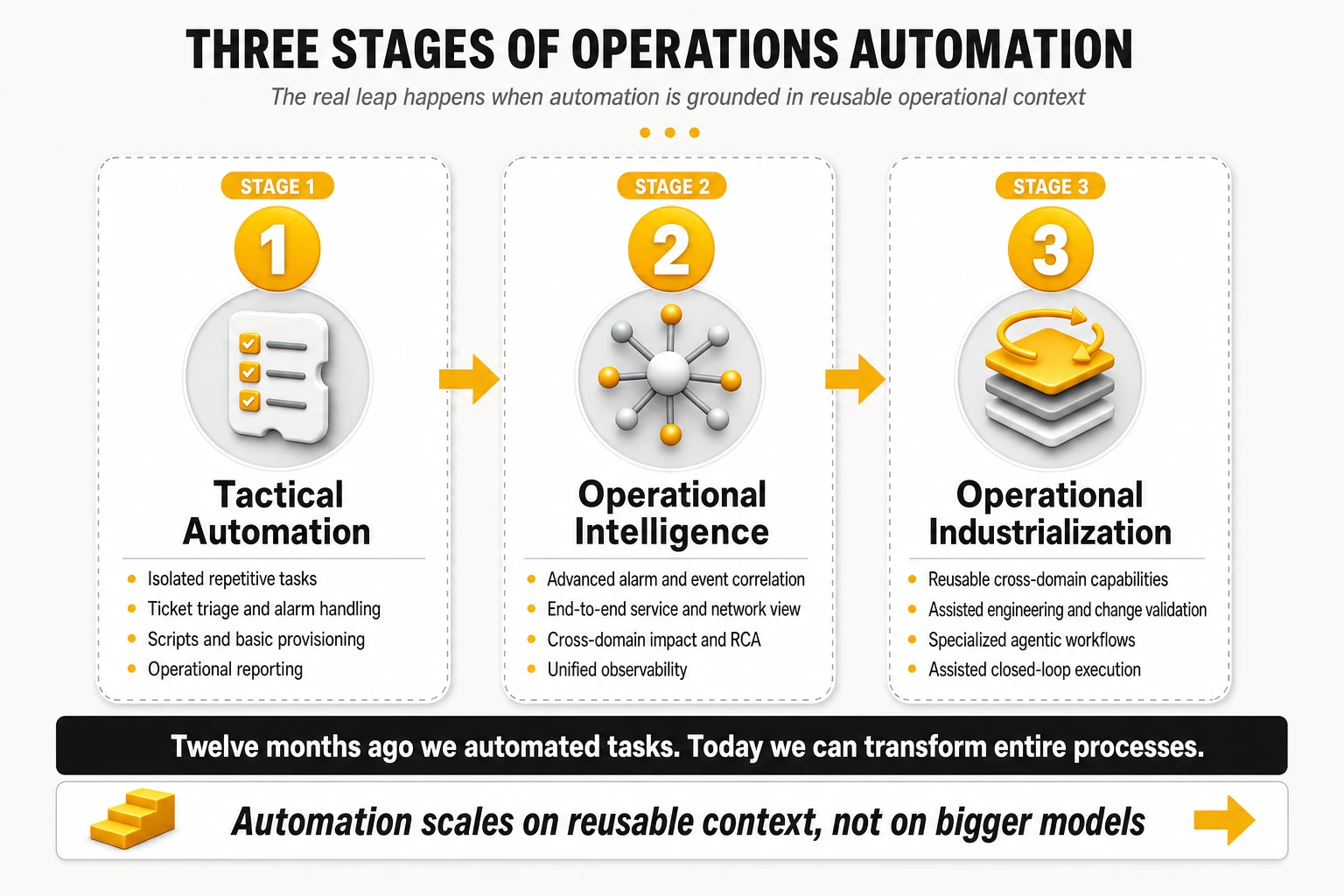
Stage 1: tactical automation
This is the automation of isolated, repetitive tasks, and most operators have plenty of it. Ticket triage, alarm acknowledgement, scripted health checks, basic service provisioning, scheduled reports. Each script does one job faster than a human, and each is a point solution: it carries its own data extraction, its own assumptions, its own fragile integration. The value is real but bounded, and it does not compound. A thousand tactical scripts do not add up to an autonomous operation — they add up to a maintenance burden that nobody dares refactor once the author moves on.
Stage 2: operational intelligence
The second stage is the ability to understand relationships, impact and dependencies across network domains. This is where advanced alarm and event correlation, end-to-end service and network visibility, cross-domain impact analysis, advanced root cause analysis (RCA) and unified observability live. The distinction from stage 1 is not “more automation” — it is context. A stage-1 script reacts to an alarm; a stage-2 system knows which service that alarm sits under, which customers are exposed, what changed recently and what the probable cause is. That requires a shared model of the network that no individual script ever had.
Stage 3: operational industrialization
The third stage is reusable capabilities that execute complex workflows across multiple domains. Full workflow automation, assisted engineering for network designs and software upgrades, pre-validation of changes before they touch production, specialized agentic workflows, decisions grounded in end-to-end context, and assisted closed-loop execution. The word that matters is reusable: a capability built for one process — say, a topology-aware impact analysis — is consumed by assurance, by change management and by capacity planning alike. Industrialization is what turns a portfolio of promising pilots into an operation that gets cheaper and faster with each additional use case rather than more complex.
The practical lesson is where the leap happens. The move from stage 1 to stage 2 is a data and context problem, not an AI problem. The move from stage 2 to stage 3 is an industrialization problem — reuse, governance, platform — not a model problem. Operators that try to jump straight to agentic autonomy on top of stage-1 foundations are placing a probabilistic decision layer on top of fragmented context, which is exactly how automation produces confident, fast, wrong actions.
2. The foundation: reusable operational context
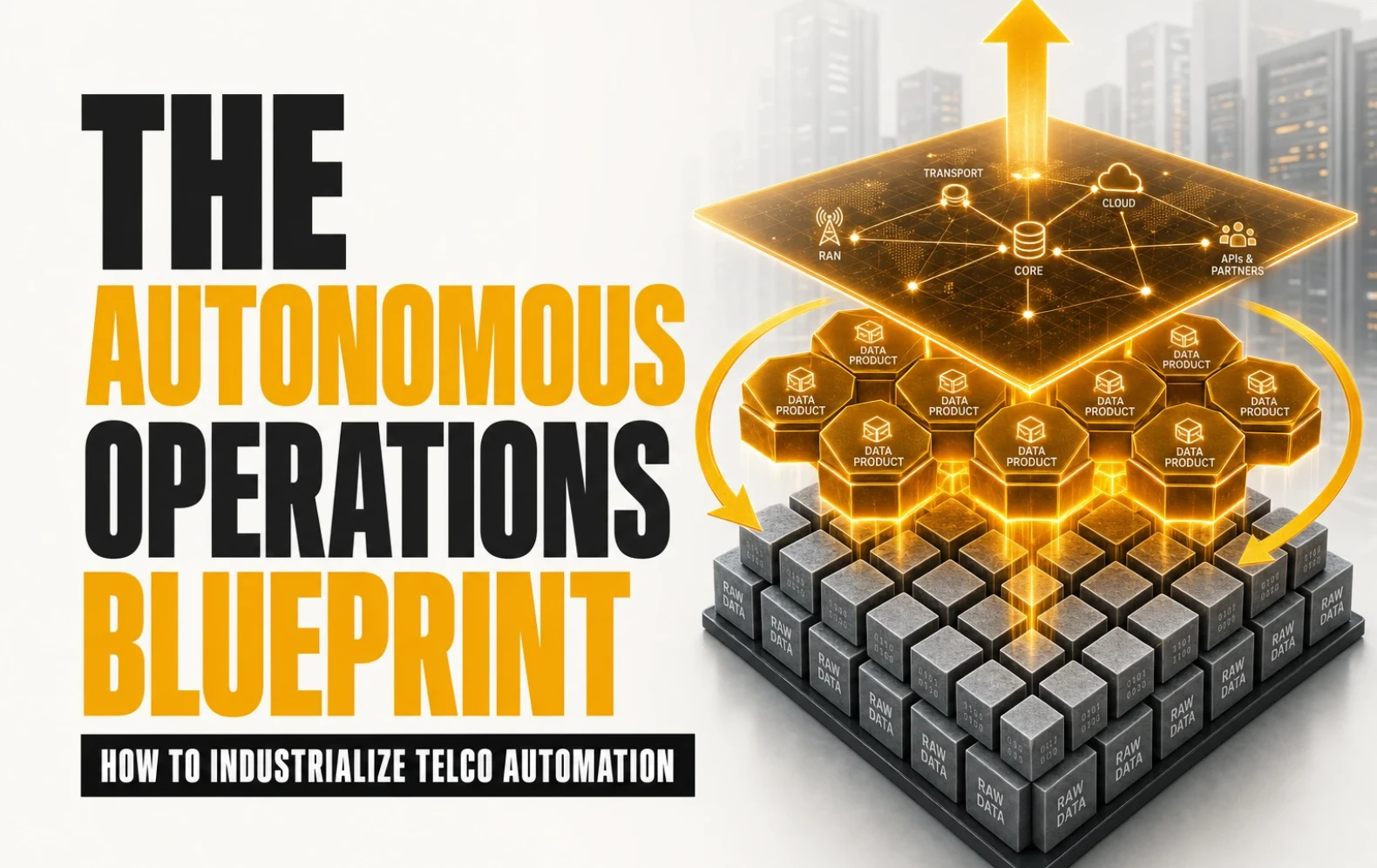
Everything practical about industrialized automation rests on one idea: build the operational context once, as reusable assets, and let every process consume it. Advanced automation does not scale because of better language models; it scales because inventories, alarms, KPIs, configuration and topology have been transformed into governed, reusable data products with a shared semantic model on top. Without that reusable context, mass automation simply does not scale — each new use case re-solves the same data problem from scratch.
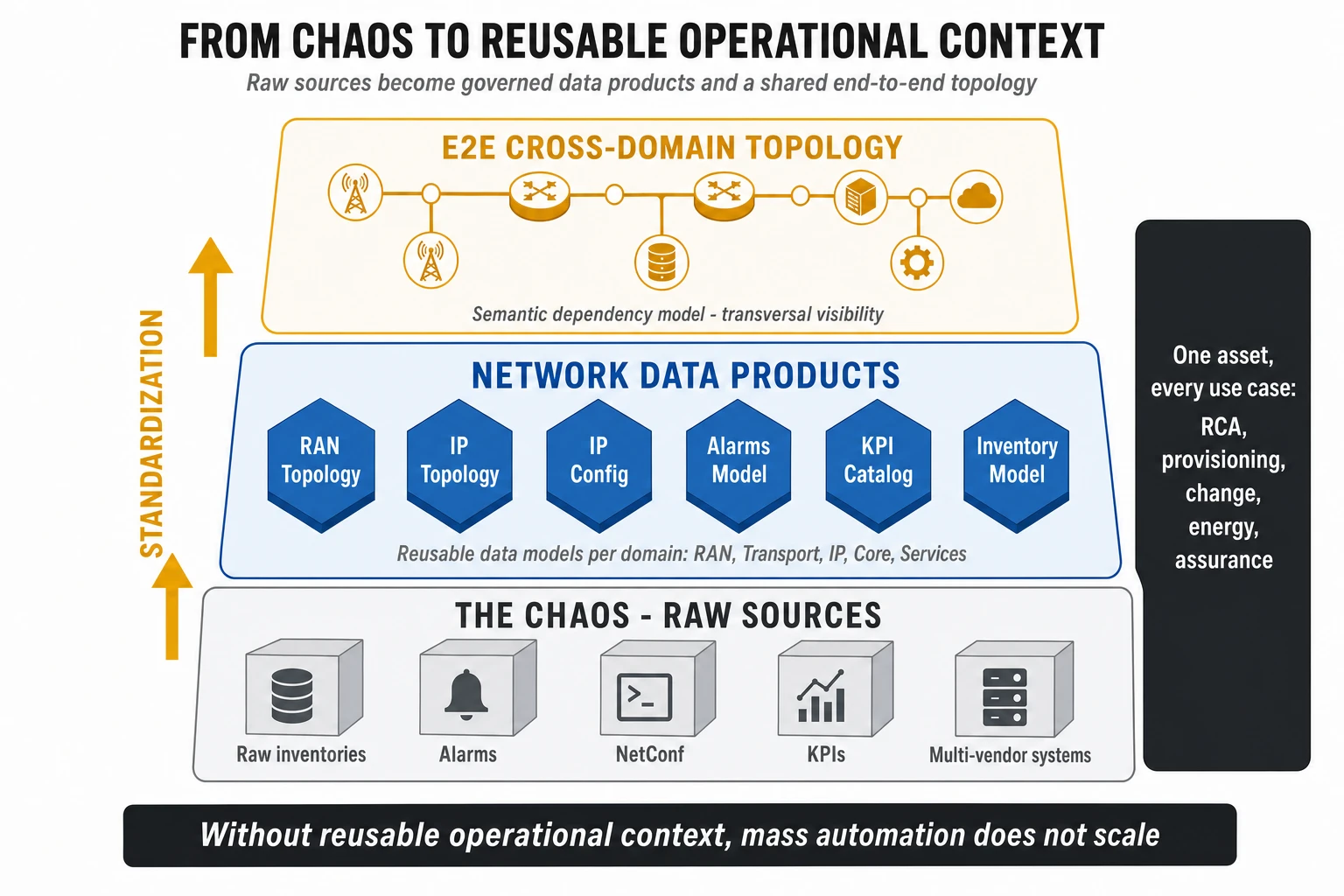
Network Data Products: decoupling data from source systems
The first foundation is to turn raw network data into products. A network data product takes the raw, source-coupled feeds — inventories, alarms, performance counters, configuration, tickets, change records — and transforms them into a reusable, versioned, documented data model per domain, exposed through an API. This is the “data as a product” principle from data mesh applied to network operations: the domain team owns the product and is accountable to its consumers, not just to its own scripts (Data Mesh Principles, Martin Fowler). The point is decoupling: consumers stop reaching into a dozen element managers and legacy OSS, and instead consume a stable model that survives the next vendor swap.
Build them in waves, per capability and per domain, not all at once. A pragmatic first wave targets the highest-leverage models across fixed and radio access, then extends to IP, transport and core:
- Inventory and topology models per domain — the logical and physical inventory reconciled to reality, with resource-to-service relationships.
- Alarm and event models — normalized alarm catalogs and event streams, decoupled from vendor-specific formats.
- Performance and KPI catalogs — consistent counter and KPI definitions in a time-series format, so “utilization” means the same thing across domains.
- Configuration models — current configuration state per domain (radio parameters, router and node config, cross-connects, VLANs), machine-readable and diff-able.
- Customer and service context — contracted services, service profiles, and the mapping from customer to service to resource that makes impact analysis possible.
The governance attributes are what make them “products” rather than “extracts”. Each data product needs an owner, named consumers, a quality SLA, a documented schema, lineage, refresh frequency, access controls and a roadmap. A feed without an owner and a quality contract is a liability the first time an AI agent trusts it; a product with those attributes is an asset every subsequent use case reuses for free.
End-to-end topology: the semantic dependency model
The second foundation sits on top of the data products: a cross-domain, end-to-end topology that models dependencies semantically. This is the single most reused asset in the whole architecture. It reconstructs the relationships and dependencies between services and every network domain — reconstructing, for example, an IP service as a graph of routers, interfaces, Layer-2 adjacencies, forwarding adjacencies and the actual forwarding path, and linking that graph downward to transport and access and upward to the customer service. Modeled once, it answers the question every process needs answered: if this element degrades, what depends on it?
The topology has to span every layer to be useful. A practical model covers fixed access, mobile access, mobile backhaul, IP, transmission and RAN neighbor relations, each linked to the layers above and below it so a path can be traced end to end:
- Vertices represent real entities — routers and interfaces, cells, nodes, service endpoints — carrying their attributes and current state.
- Edges represent typed relationships — “contained in”, “adjacent to”, “next forwarding hop”, “depends on” — so the graph encodes not just connectivity but causal and containment semantics.
- Cross-layer links tie each domain graph to the ones above and below it, so a customer service resolves down to the specific fiber, wavelength, cell and router it rides on.
This is the difference between detecting a fault and understanding it. Multi-domain RCA, impact-based prioritization, pre-change blast-radius analysis, and safe agent action all consume the same topology graph. It is why the topology is built as shared infrastructure, owned centrally and versioned, rather than re-derived inside each tool — and why it aligns with the intent-driven, context-aware, knowledge-guided model the reference architectures describe (TM Forum IG1251).
Knowledge, observability and the service model
Three more foundations complete the reusable context, and each is consumed by every process. They are the difference between an AI that reasons about the real network and one that produces plausible fiction:
- A knowledge layer — procedures, runbooks, past incidents and their resolutions, policies, causal models and expert know-how, represented as graphs, ontologies and versioned documents. This is the grounding source that keeps generative models anchored; an agent quoting a seven-year-old runbook with total confidence is not intelligence, it is automated archaeology. Knowledge must be versioned, owned, dated, and stripped of obsolete content, aligning with the knowledge base at the heart of the ITU-T autonomous-networks architecture (ITU-T Y.3061).
- End-to-end observability — metrics, logs, traces, alarms, events, flows and experience data unified over the data products, ingested in real time (OpenTelemetry-style streaming rather than nightly extracts) so that state is live, not stale (OpenTelemetry). It has to answer, for any incident: what is happening, where, since when, what changed, which service and which customers are affected, the probable cause, and what happens if nobody acts.
- A service and catalog model — products, services, components, dependencies, SLAs, policies, deployment and recovery rules. Without a model of what a service is, orchestration cannot know what it is protecting, and no closed loop can judge whether an action helped or harmed.
These five foundations — data products, topology, knowledge, observability, service model — are built once and reused everywhere. That single sentence is the entire economic argument for industrialization. The cost of the foundation is front-loaded and shared; the marginal cost of each new automated process falls as the context matures. Skip the foundation and every use case pays the full data-integration tax again, which is precisely why isolated pilots never reach production scale.
3. The closed-loop engine: one pattern behind every process
The second reusable asset, after the context, is the control loop itself. Every automated process — assurance, change, provisioning, optimization, resilience — runs the same closed loop over the shared context. Building it once, as a governed engine rather than as bespoke logic inside each use case, is what lets a new process be stood up by configuration rather than by reinvention. The common five-step framing (observe, detect, propose, evaluate, act) is correct but incomplete; to operate safely on a live network it expands to eight phases.
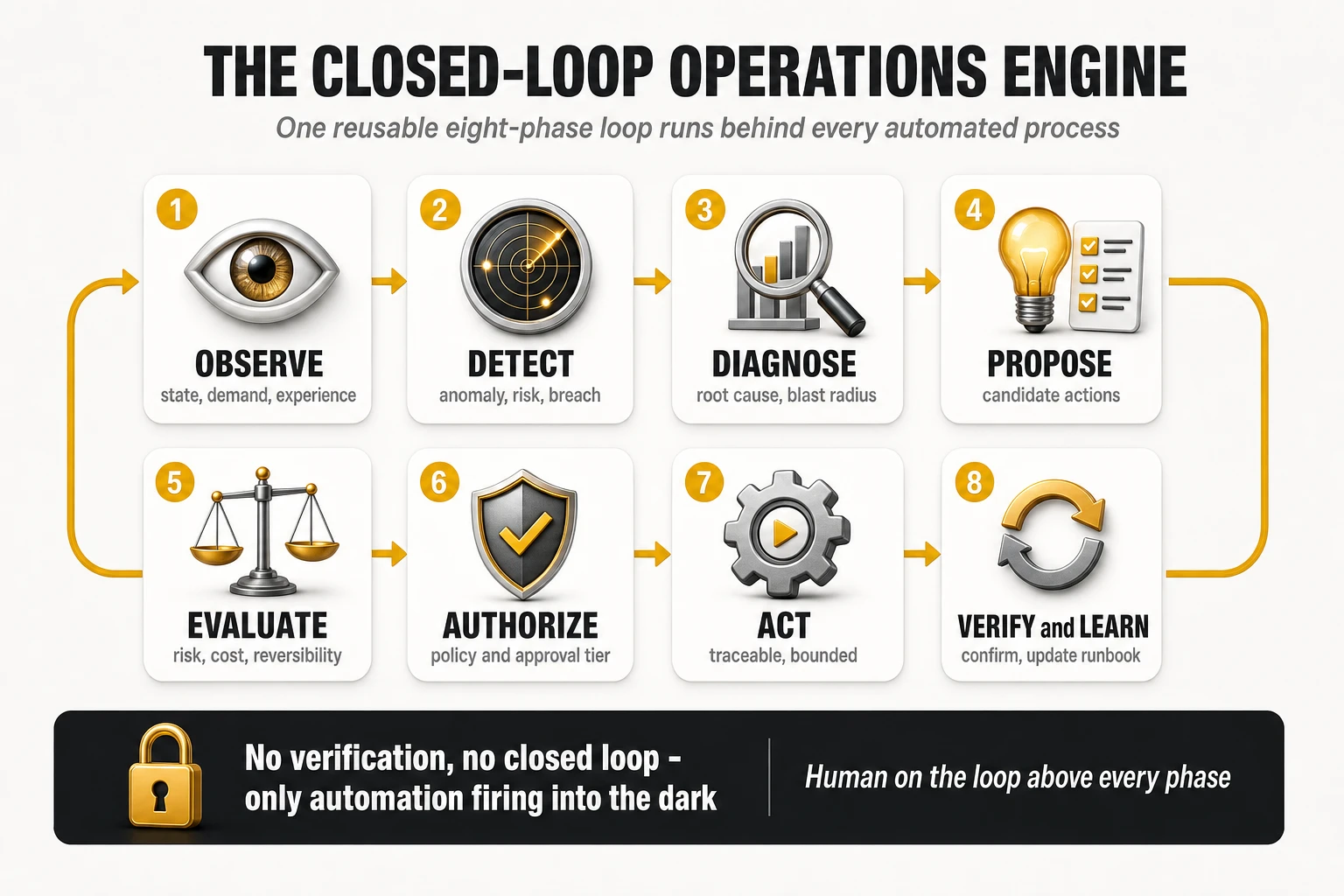
The eight phases
- Observe — collect state, demand, performance, experience, events, changes and risk context from the observability layer.
- Detect — identify deviations, anomalies, future risks, SLA breaches, optimization opportunities or a change of intent, using learned baselines rather than static thresholds.
- Diagnose — determine probable cause, scope, dependencies, affected services and customers, and expected evolution, by reasoning over the topology graph.
- Propose — generate candidate actions: reconfigure, scale, reroute, repair, restart, patch, protect a segment, notify the customer, open an incident, or explicitly do nothing and keep watching.
- Evaluate — score each candidate on success probability, risk, cost, time, impact, reversibility, compliance, experience and compatibility with other active intents.
- Authorize — decide the execution mode by risk tier: automatic, automatic with notification, automatic within limits, requires approval, requires dual approval, or forbidden.
- Act — execute through controlled interfaces with traceability, sequence control, monitoring, scope limits, error handling and a ready rollback path.
- Verify and learn — confirm the objective was met, check for side effects, validate the diagnosis, and update runbooks and models under control. No verification, no closed loop — only automation firing into the dark and trusting providence.
The two phases operators most often omit are authorize and verify — and they are the ones that make autonomy safe. Authorize is where policy-as-code decides, per action and per risk tier, whether a human must be in the loop. Verify is where the loop closes and learning happens. A pipeline that observes, decides and acts without those two phases is not an autonomous operation; it is an unsupervised one, and the distinction shows up the first time a confident action degrades a service nobody realized was dependent.
Hierarchical loops: fast local, coordinated global
The loop is not monolithic — it is layered, matching the three operational layers of the reference architecture. Fast, lightweight loops run inside each domain (radio, transport, core) for sub-second local decisions; a service-layer loop coordinates end-to-end across domains; and a business-layer loop sets intent and priorities. The domains encapsulate their own autonomy but expose capabilities and constraints upward through standard reference points, so end-to-end autonomy is composed from domain autonomy rather than centralized into a single brain (TM Forum IG1251). Push intelligence down for speed; keep coordination up for coherence. Fully centralizing every decision recreates the monolith, now decorated with the word “agentic”.
4. The industrialization pipeline and the agent layer
Between the closed loop and the live network sits the mechanism that makes AI action safe: a standardized industrialization pipeline that every autonomous change flows through. This is what turns a probabilistic proposal into a deterministic, audited, reversible action. The same pipeline is reused by every process, which is why an operator can add a new autonomous use case without re-inventing its safety machinery.
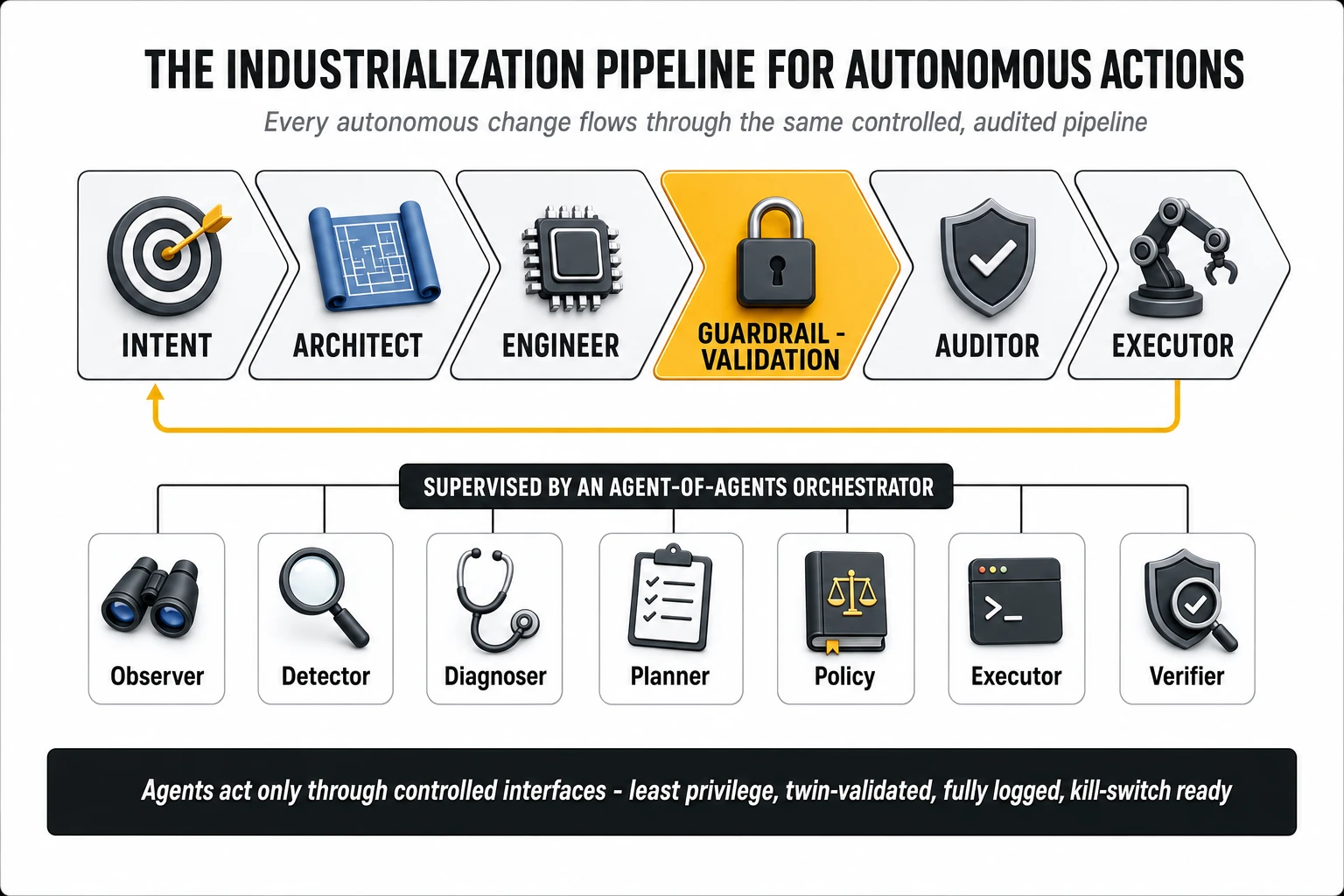
The pipeline: intent to controlled execution
Read the pipeline as a chain of accountable stages, not a single AI call. An intent enters, and each stage adds a control before anything reaches the network:
- Intent — a business or service objective, expressed as a desired outcome with its constraints (SLA, affected segments, priority, allowed risk, cost ceiling, time window, regulatory and security conditions), standardized through an intent interface such as the TMF921 Intent Management API (TMF921).
- Architect — decompose the intent into technical objectives per domain, resolve conflicts with other active intents, and define success conditions and action boundaries.
- Engineer — translate objectives into concrete, parameterized changes against the configuration models, reusing tested automation building blocks rather than free-form commands.
- Guardrail / validation — the critical gate: check the proposed change against policy-as-code and, wherever possible, simulate it in a digital twin of the network before it touches production, quantifying blast radius and catching cross-service degradations.
- Auditor — record the full decision trail — inputs, reasoning, policy checks, approvals — so every autonomous action is explainable and reconstructable after the fact.
- Executor — apply the change through controllers and tested automations with least privilege, idempotency, scope limits, monitoring and rollback, never by an agent issuing raw commands directly.
Specialized agents, not one omniscient agent
The AI layer is a division of labor across specialized agents, each with a narrow remit, coordinated by an orchestrator. This mirrors the agent architecture the standards bodies are converging on for Level 4 operations (TM Forum IG1251D). The recurring roles are:
- Observer gathers context and summarizes state; Detector separates signal from noise and estimates severity.
- Diagnoser forms hypotheses against the topology and precedent; Planner generates and sequences candidate actions and estimates impact.
- Policy agent checks permissions, restrictions and whether approval is required; Executor invokes tested automations and halts on deviation.
- Verifier compares expected versus actual state and requests rollback; Learning agent records outcomes and proposes controlled updates to runbooks and models.
Coordination is itself a governed function, not an emergent hope. An orchestrating “agent-of-agents” arbitrates between agents that would otherwise collide — the classic case being an energy agent that wants to sleep a cell while an experience agent needs its capacity for a priority service. Arbitration runs on policy-as-code with priorities set by business intent. As agents from different suppliers enter the same loops, interoperability standards such as the Model Context Protocol for tool access and the TM Forum A2A-T protocol for agent-to-agent delegation and negotiation become the mechanism that prevents a new generation of lock-in (TM Forum IG1453 A2A-T).
One discipline is non-negotiable: not everything should be an LLM. Generative models are the right tool for interpretation, context, planning, coordination, language and unstructured knowledge. They are the wrong tool for simple rules, deterministic operations, exact calculations, security controls, low-level execution and validations that demand certainty. A mature architecture combines deterministic rules, statistical detection, mathematical optimization, machine learning and generative reasoning — each where it belongs — rather than routing everything through a model because it is fashionable.
5. Process by process: what “automated” actually means
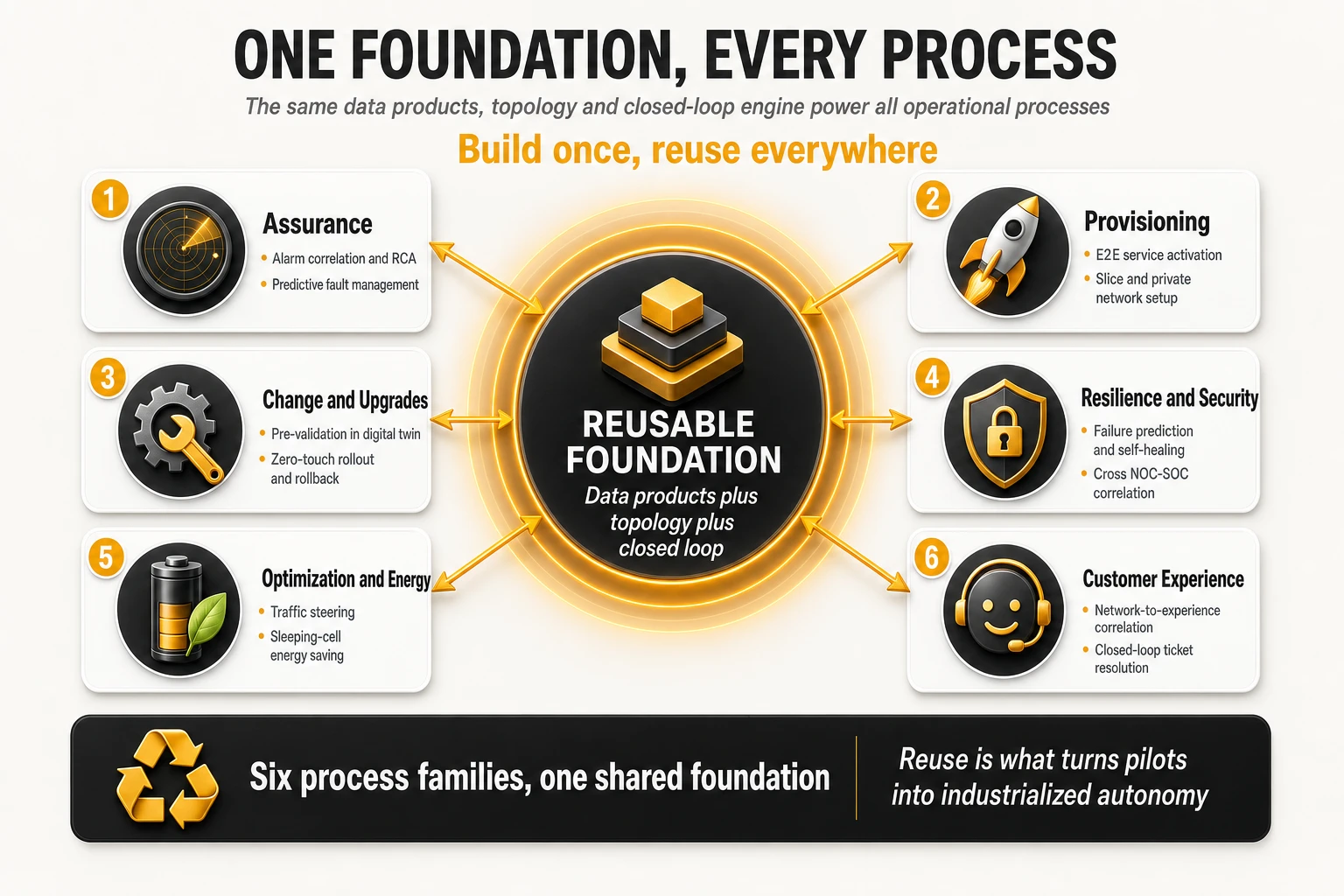
Here is the practical payoff of the foundation: every operational process reuses the same data products, topology and closed-loop engine, and differs only in which detection, diagnosis and action logic it configures. The sections below walk the main process families. Note how each one consumes the same shared context — that is the whole point of building it once.
Service detection and monitoring
The first process to industrialize is detection, because everything downstream depends on it. Static thresholds are replaced by unsupervised models that learn each cell’s, link’s and function’s normal behavior from the KPI data products and flag deviations — including the silent quality-of-experience degradations that never breach a fixed threshold. Detection consumes the observability layer and the service model, so an anomaly is immediately expressed as “service X degraded for customer segment Y”, not “counter Z crossed a line”. This is the observe and detect phases of the loop, and getting it trustworthy in shadow mode is the precondition for automating anything beyond it.
Mass event correlation: taming the alarm storm
The highest-volume pain in any NOC is the alarm avalanche, and it is the clearest showcase of reused topology. A single fiber cut can generate thousands of orphan alarms across multiple layers. The correlation engine consumes the alarm data products and the end-to-end topology graph, applies causal inference over the dependency model, and compresses the storm into a single root-cause incident — routinely cutting actionable event volume by an order of magnitude. This is the diagnose phase, and it works only because the topology already exists as a reusable asset: the same graph that powers correlation also powers impact analysis and change validation.
Trouble ticketing and incident resolution
Ticketing moves from a human queue to an assisted, then autonomous, closed loop. When an incident is raised, the loop enriches it with diagnostic context from the topology and observability layers, retrieves precedent from the knowledge layer, and proposes a remediation playbook with a success probability based on history. At lower risk tiers a NOC auto-resolution agent executes and verifies the fix, closing the ticket automatically; at higher tiers it hands a fully prepared recommendation to an engineer. The reusable ingredients are the knowledge layer (for playbooks and precedent) and the executor (for the fix) — both shared with every other process. The public frontier shows the ceiling: agentic RAN operations have compressed major-event handling from hours to about a minute, a more than 95% improvement (Deutsche Telekom, 2026).
Change and upgrades: the zero-touch, twin-validated path
Network change is where automation done carelessly is most dangerous and done properly is most valuable, because configuration error is a leading cause of major outages. The industrialized change process runs every change through the pipeline: dependency analysis against the topology, compatibility validation, and — critically — simulation in a digital twin before anything reaches production. The twin quantifies blast radius and catches the cross-service degradation that a human reviewer misses. Execution is staged with automatic verification and rollback, and the inventory and configuration data products are updated as part of the change rather than weeks later. This is where the reuse of the digital twin as first-class infrastructure pays off: the same twin that validates a change also rehearses an energy action or a reroute.
Provisioning and activation
Service provisioning becomes intent-driven end-to-end orchestration. A business intent — activate a service, stand up a network slice, provision a private network, deliver enterprise connectivity — enters the pipeline, is decomposed against the service model, reserves and configures resources across radio, transport and core simultaneously, validates pre-activation and self-corrects errors. The reused assets are the service catalog model (to know what is being built) and the orchestration engine (to build it). The direction of travel is measured in the reduction of service delivery time from days or hours to minutes, and the compression of order-to-activation cycles — the standardized metric here is service delivery time, or SDT.
Optimization and energy
Optimization is a continuous closed loop rather than a periodic campaign, and energy is its highest-value instance. The loop consumes performance and traffic data products, predicts demand and congestion, and acts: cell optimization, load balancing, interference management, parameter tuning, traffic steering and — the domain where the first Level 4 certifications landed — predictive energy management. An energy loop learns per-cell traffic signatures, places cells into deep-sleep states in sub-second windows and restores capacity the instant demand returns. The measured results define the prize: roughly 20% RAN energy conservation with zero customer-experience impact in one live commercial network, and about 5% less energy per gigabyte with an estimated 800 MWh saved in another (Rakuten Mobile, 2026; Converge Digest, 2025).
Resilience and the NOC-SOC convergence
Resilience automates prediction and recovery; security automation reuses the exact same context with stricter controls. The resilience loop predicts unavailability, protects critical services, reroutes traffic and self-heals — with the same failure simulated in the twin first. Security operations correlate SIEM events against network anomalies in real time over the shared observability and topology layers, diagnose intrusions and isolate compromised resources dynamically. The practical convergence is that a latency spike (a network symptom) and anomalous traffic (a security symptom) are frequently the same root event seen from two silos; running both over one context is what lets a converged operation stop opening duplicate tickets for one problem. Security actions run through the same pipeline but sit in higher risk tiers with mandatory approval.
Customer experience: closing the network-to-experience gap
The most common structural defect this architecture fixes is that experience and network quality are measured in separate silos. Industrialized CX correlates the chain customer → service → network → incident → action over the shared context, so a drop in experience resolves to a specific network cause and a specific remediation. On top of that sit generative copilots for contextual assistance, automatic problem detection, intent prediction and closed-loop customer-ticket resolution. The reused assets are the customer-and-service context data product and the knowledge layer — the same ones assurance and provisioning consume. This is also where the operation connects to revenue: fewer customer-impacting incidents, faster resolution and experience-backed premium SLAs.
The same pattern across every domain
Each network domain applies these processes with domain-specific logic but the identical foundation and loop. The reuse is what makes a broad, growing use-case roadmap tractable rather than a portfolio of one-off integrations:
- RAN — engineering assistants for design and configuration, performance optimization, and sleeping-cell energy agents, with fast local loops running inside the radio domain.
- Fiber and fixed access — topology assistants, network image analysis, and contract analysis, all feeding the fixed-access inventory and topology products.
- Core — log analysis and call-detail-record anomaly detection over the core data products.
- IP and transport — L2/L3 VPN provisioning, path and congestion optimization, and reroute automation over the IP topology graph.
- NOC — incident correlation and resolution, auto-resolution agents, and field-services advisors that dispatch and guide technicians.
- SOC — CX-to-network-performance correlation, operational CDR and CX insights, and closed-loop customer-ticket automation.
- Outside plant — site certification with image recognition and incident-management automation.
Above all of these sits a multi-agent orchestrator that spans domains and the service lifecycle — design, build/deploy, operate/optimize — so that a cross-domain use case such as multi-domain RCA is coordinated rather than stitched together by hand. The roadmap of use cases is deliberately broad and incremental: each new one is cheaper than the last because it reuses the foundation.
6. Governance and guardrails: acting safely on a live network
The more autonomy a process gets, the more engineered safety it needs — and safety is designed in from the first deployment, not retrofitted. Probabilistic models acting on deterministic critical infrastructure require an explicit control regime. Three mechanisms carry most of the weight.
Risk tiers set the autonomy budget
Every action is classified by risk, and the risk tier decides how much autonomy it gets. This is the practical content of the authorize phase:
- Low risk — reports, correlation, recommendations, queries, documentation updates. Full autonomy is acceptable.
- Medium risk — ticket creation, reversible adjustments, limited changes, escalations. Requires bounds, validation and monitoring.
- High risk — mass changes, critical elements, security actions, emergency services, sensitive data, irreversible or cross-domain actions. Requires approval, simulation or dual control.
Guardrails every operational agent needs
An agent allowed to touch the network carries a fixed set of controls, without exception: its own identity, least-privilege permissions, an authorized tool list, scope limits, policies, cost and time and frequency controls, a confidence threshold, complete logging, decision explainability, deviation detection, rollback, a kill switch, human supervision and periodic evaluation. Grounding is the structural defense against hallucination: an agent’s plan is checked against the ontology and an allowed-procedure catalog before execution, so a command that violates an engineering rule is blocked rather than run confidently.
The model and agent lifecycle
Models and agents are promoted through a controlled lifecycle, and the jump from lab to live is prohibited. The stages are design, training or configuration, validation, offline test, simulation, shadow mode, recommendation-without-execution, limited execution, gradual expansion, full operation, monitoring, and retirement or replacement. Trust is earned across months of shadow-mode operation with measured false-positive rates and explainable outputs — a sociotechnical process no procurement cycle shortcuts. Automations and models also age: they must be maintained, re-evaluated and retired, because an operation that never retires stale automations accumulates silent risk.
7. How to organize: streams, roles and the federated model
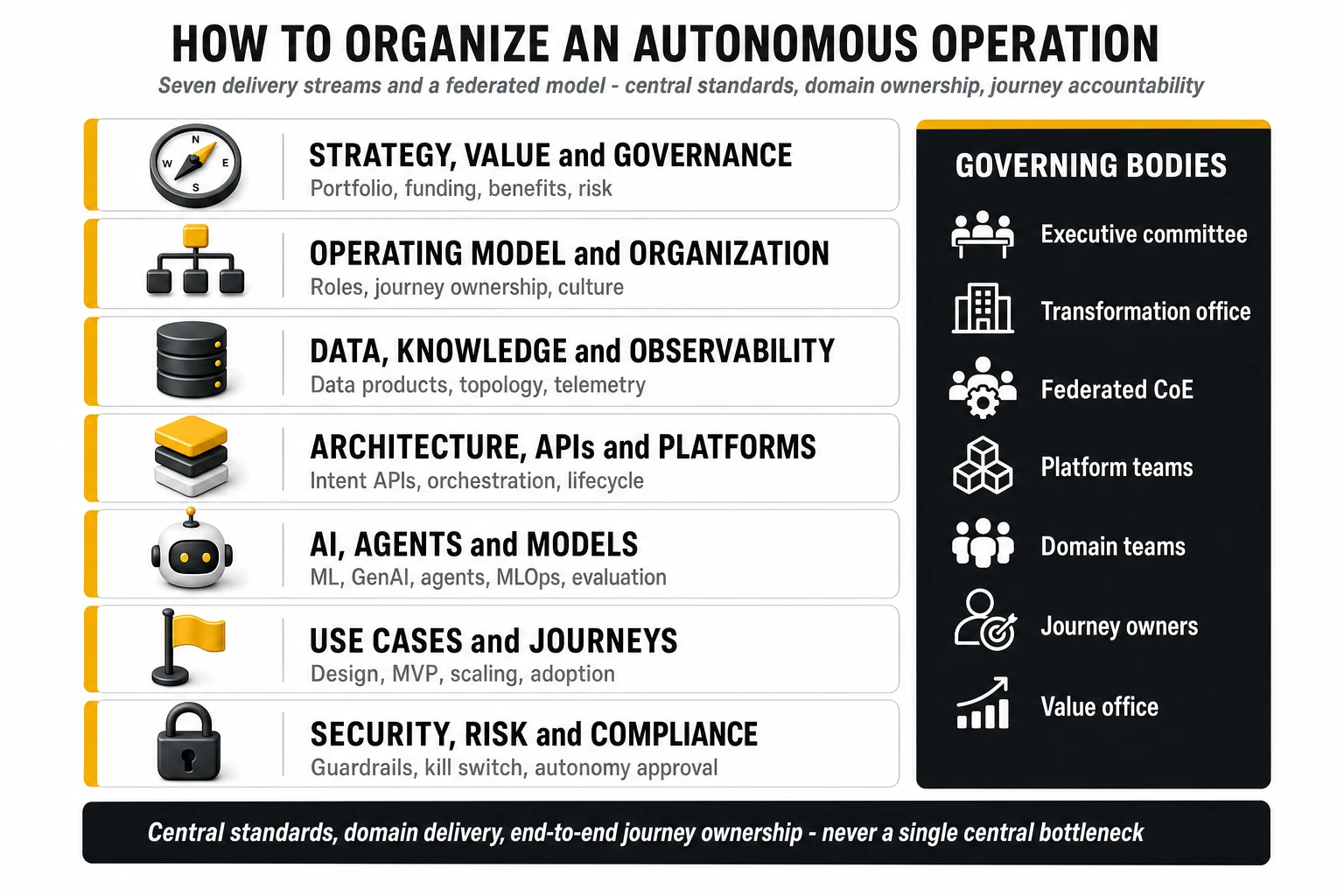
The architecture only industrializes if the organization is built to match it, and the organizing principle is federation with common governance. Two failure modes bracket the right answer: a central team that tries to design and control every automation becomes a bottleneck, and fully independent domains build incompatible solutions. The workable model keeps standards, platforms and governance central; delivery, use cases and operation in the domains; and end-to-end accountability with journey owners who cut across the org chart.
Seven delivery streams
A realistic program organizes into seven streams, each with a clear remit:
- Strategy, value and governance — vision, portfolio, funding, benefits, risk and executive reporting.
- Operating model and organization — roles, teams, product model, journey ownership, processes and cultural change.
- Data, knowledge and observability — data products, quality, topology, inventory, telemetry, correlation and the knowledge base.
- Architecture, APIs and platforms — reference architecture, integration, intent and open APIs, orchestration, automation and lifecycle.
- AI, agents and models — analytics, machine learning, generative models, agents, MLOps, evaluation, model registry and reuse.
- Use cases and journeys — design, MVP, rollout, scaling, KPIs, improvement and adoption.
- Security, risk and compliance — access, policies, audit, model risk, continuity, kill switches and approval of autonomy levels.
The governing bodies and the critical role
A small set of bodies keeps the federation coherent without centralizing delivery. An executive committee decides ambition, priorities, funding, risk and the acceptance of autonomy levels; a transformation office maintains the roadmap and removes friction without becoming a bureaucracy that demands presentations from the people doing the work; a federated center of excellence sets reference architectures, agent patterns, data standards, model registry, evaluation and reusable tooling while leaving use-case ownership in the domains; platform teams run the shared data, observability, automation, orchestration, twin and model platforms as internal products; and a value office separates theoretical efficiency from real, booked savings.
The single most important role is the journey owner. Without an owner accountable for an end-to-end outcome — activation time, SLA compliance, resolution rate, experience, availability, end-to-end cost, automation level, incidents caused by changes — each domain optimizes its own fragment and nobody answers for the complete result. The workforce shift underneath is from console operators executing tasks to engineers designing policies, building closed loops and supervising exceptions; the expert knowledge does not disappear, it moves into the design of loops, models, policies and guardrails.
8. Measuring it: metrics that separate motion from progress
Counting bots and scripts measures activity, not transformation — the metric set has to trace technical capability up to business value. The TM Forum hierarchy of Key Business, Effectiveness and Capability Indicators (KBI/KEI/KCI) forces that traceability, and the ITU-T evaluation work defines the standardized formulas (ITU-T Y.3061). In practice, a transformation dashboard tracks several families at once:
- Business and experience — time-to-market, activation time, cost per operation, retention, NPS, complaints avoided, SLA compliance.
- Network and service — availability, MTTR, mean time to detect, repeat failures, failed-change rate, energy consumption.
- Automation — the operations automation rate (tasks completed with zero human involvement over total tasks), closed-loop coverage, rollback rate and incidents caused by automation.
- AI and data — precision, false-positive rate, drift, human acceptance and override rates, and the completeness, freshness and lineage of the data products.
The one composite worth constructing is an autonomy index that weights coverage, not just level. Expressed simply as coverage × level × volume × value × reliability, it prevents the common vanity metric where a Level 4 loop covering 2% of a process is reported as a bigger achievement than a Level 3 loop covering 80% of the volume. Autonomy that handles the mass of real work at Level 3 beats a showcase Level 4 handling almost nothing — and the index makes that visible to executives who would otherwise read the certificate and stop.
9. The first twelve months: a concrete sequence
The build has a natural order, and it is disciplined about not buying the top of the stack before the bottom exists. A design-and-diagnostic phase of roughly sixteen weeks precedes it: establish governance, score maturity granularly per domain and per journey, baseline the KPIs, audit the data estate, map in-flight initiatives, define the target architecture and select five to ten priority journeys. Then the first year:
- Months 0-3 — foundations of governance and context. Stand up the federated CoE and the seven streams; define KPIs and baselines; pick two or three quick wins and one transformative end-to-end case; begin the first data products and the topology model. No large platform purchase before this is done.
- Months 3-6 — build the reusable assets. Normalize the priority processes, build the highest-leverage data products, stand up streaming observability, implement the knowledge repository, develop first detection and correlation models, and run everything in shadow mode while validating security and designing the agent model.
- Months 6-9 — first closed loops in production. Move low-risk loops to limited production, integrate two domains, instrument automation monitoring, measure against baselines, adjust roles, industrialize the emerging patterns and start the main end-to-end case.
- Months 9-12 — scale what works, retire what does not. Expand successful cases, kill pilots without value, introduce coordinating agents on bounded tasks, define the year-2 and year-3 roadmap, consolidate the operating model, review booked benefits and set per-journey autonomy targets.
By the end of year one the operation should have banked assets, not slideware: a reliable baseline, functioning governance, an approved architecture, initial shared platforms, the priority data products and topology, several cases in production, first closed loops, federated teams, live metrics, a funded roadmap and evidence of value. The maturity target for the year is honest — move selected journeys from manual or assisted to partial or conditional autonomy, reach Level 3 in a few bounded cases, and explicitly avoid the fantasy of network-wide Level 4.
10. The errors that reliably kill these programs
The failure modes are well documented and almost always organizational or sequencing errors, not technology gaps. Naming them is the cheapest insurance a program can buy:
- Treating it as a platform purchase. A platform does not replace the operating model, the data, the processes, the governance, the roles, the architecture or the cultural change — it only serves them.
- Automating broken processes. Eliminate steps, simplify, normalize, clarify responsibilities and resolve frequent exceptions before automating, or you industrialize the mess at machine speed.
- Optimizing each domain in isolation. Local wins that worsen end-to-end experience, availability, cost or risk are the predictable result of missing journey ownership.
- Confusing a copilot with autonomy. A chatbot that queries documentation is useful but is not a closed loop; autonomy requires observe, decide, act and verify.
- Scaling a proof of concept before industrializing it. Production demands security, performance, monitoring, versioning, testing, integration, cost control, governance and continuity that a PoC never had.
- Promising benefits without a baseline. Reference percentages from other operators are not transferable without analyzing the starting point, scope, volume, technology, process and exact metric definition.
Underneath all of them is one pattern: the technology outruns the organization. Engineers who distrust model outputs re-verify everything manually and erase the gains; management measured on headcount resists role conversion; finance treats enabler investment as discretionary the first hard quarter. The countermeasures — shadow-mode trust-building, explainability as a requirement, retraining committed early and publicly, executive sponsorship that survives budget cycles — must be planned with the same rigor as the architecture. Culture is a dimension of the maturity model for a reason.
11. Conclusion: build once, reuse everywhere, govern always
The practical blueprint compresses to a short, unglamorous sequence. Turn raw data into governed data products; build one end-to-end topology and one knowledge layer on top; run a single eight-phase closed loop over that context for every process; route every autonomous action through one industrialization pipeline with twin validation, policy-as-code and audit; specialize the agents and coordinate them under an orchestrator with humans on the loop; and organize the whole thing as a federation with central standards, domain delivery and journey ownership. Do that, and each new automated process is cheaper, faster and safer than the last.
The order is not negotiable. Processes and data before automation; automation before orchestration; orchestration before AI; AI before agents; agents before digital twins. Skipping layers does not accelerate the journey — it front-loads the risk. The digital twin and the agentic orchestration do not belong on top of inexact inventories and broken manual processes, however futuristic the diagram looks. The operators banking real energy, fault-reduction and cycle-time results built the boring foundation first, and it is the reuse of that foundation — not the sophistication of any single model — that turned their pilots into an industrialized operation.
The transferable principle is a single sentence. Autonomy is not a layer of AI over the NOC; it is the redesign of how the operation translates business and customer objectives into governed network behavior — and it becomes real when data, architecture, organization, security and value are built as reusable assets and run through one common loop, rather than reinvented for every use case.
At TelcoCrux, we help operators turn the autonomy vision into an industrialized operating model — the reusable data foundations, the closed-loop architecture and the governance that actually scale beyond pilots. If you want a pragmatic, vendor-neutral blueprint for building automation toward the highest autonomy levels, let’s talk.